

Business Growth: Digital Agency vs Freelancers – Which Is Better in 2026?

In 2026, UK small businesses face a familiar challenge: how to build a strong digital presence without overspending or losing control of quality. With so many options available, the decision often comes down to two choices—working with freelancers or partnering with an all-in-one digital agency. Both have advantages, but the right choice depends on your goals, resources, and long-term plans.
What Is an All-in-One Digital Agency?
Table Of Content
- What Are Freelancers in the Digital Industry?
- Cost Comparison: Agency vs Freelancers
- Upfront and Ongoing Costs
- Hidden Costs
- Quality, Consistency, and Reliability
- Digital Agency Consistency
- Freelancer Variability
- Scalability and Long-Term Growth
- How Agencies Support Scaling
- Limitations of Freelancers
- Communication and Project Management
- Agency Structure
- Freelancer Communication
- When Freelancers Are a Better Choice
- When an All-in-One Agency Is Better
- Hybrid Approach: Best of Both Worlds
- Common Mistakes Businesses Make When Choosing
- Choosing Based Only on Price
- Ignoring Long-Term Business Goals
- Poor Vetting and Research
- Lack of Clear Objectives
- Conclusion
An all-in-one digital agency is a company that provides a complete range of digital services under one roof. Instead of hiring separate providers for each task, businesses work with a single team that manages everything from strategy to execution.
These agencies are designed to offer a unified approach to digital growth. Rather than treating services in isolation, they connect every part of your online presence to ensure consistency and performance.
Typically, an all-in-one digital agency may include services such as:
- Website design and development
- Search engine optimisation (SEO)
- Digital marketing and paid advertising
- Branding and graphic design
- Content creation and copywriting
- Automation and CRM integration
- Hosting and technical support
The key advantage is coordination. All departments work together, meaning your website, marketing campaigns, and branding follow the same strategy and goals.
For UK businesses, this is especially useful because it reduces the need to manage multiple contacts and ensures a more streamlined and reliable workflow. Instead of juggling different freelancers or agencies, everything is handled in one place with a clear strategy guiding the entire process.
What Are Freelancers in the Digital Industry?
Freelancers are independent professionals who offer specialised digital services on a project or contract basis. Unlike agencies, they typically work alone and focus on one or two areas of expertise, such as web design, SEO, content writing, or social media management.
In the UK digital market, freelancers are widely used by startups and small businesses due to their flexibility and lower upfront costs. Many are found through platforms like Upwork, Fiverr, or through direct referrals and networking.
Freelancers usually operate on a task-by-task basis, which means businesses can hire them only when needed. This makes them a popular choice for short-term projects or businesses with limited budgets.
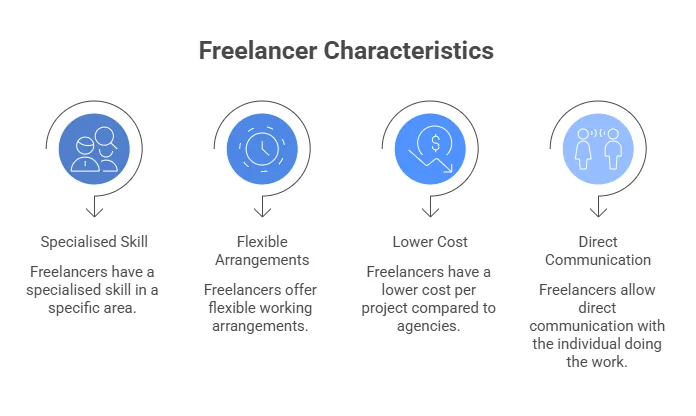
Common characteristics of freelancers include:
- Specialised skill in a specific area
- Flexible working arrangements
- Lower cost per project compared to agencies
- Direct communication with the individual doing the work
However, freelancers generally work independently, which means they may not always be aligned with other aspects of your business strategy unless carefully managed. If multiple freelancers are involved, coordination becomes the responsibility of the business owner, which can sometimes lead to inconsistency or delays.
Despite this, freelancers remain an important part of the digital ecosystem, especially for businesses that need quick, affordable, and targeted support.
Cost Comparison: Agency vs Freelancers
One of the biggest factors UK small businesses consider when choosing between an all-in-one digital agency and freelancers is cost. On the surface, freelancers often appear more affordable, but the real comparison is not always that straightforward.
Upfront and Ongoing Costs
Freelancers typically charge per task or hourly rate, which can make them attractive for businesses with limited budgets. For example, you might pay one freelancer to design a logo, another to manage SEO, and another to build your website. This allows you to control spending on individual tasks.
An all-in-one digital agency, on the other hand, usually works with fixed packages or monthly retainers. While the upfront cost may be higher, you are paying for a complete, integrated service that covers multiple areas of your digital presence.
In many cases, agencies provide better long-term value because everything is managed under one strategy, reducing inefficiencies and repeated work.
Hidden Costs
What many business owners overlook are the hidden costs involved in working with freelancers. These can include:
- Time spent managing multiple individuals
- Extra coordination between different service providers
- Revisions due to inconsistent work styles
- Delays caused by availability issues
When you add up these factors, the overall cost of managing freelancers can become higher than expected, especially for growing businesses that need ongoing support.
Agencies reduce these hidden costs by offering a centralised system where communication, delivery, and strategy are handled in one place.
Quality, Consistency, and Reliability
Beyond cost, the quality and consistency of work play a major role in deciding between freelancers and an all-in-one digital agency. For UK businesses aiming to build a strong brand, these factors can directly impact customer trust and long-term success.
Digital Agency Consistency
An all-in-one digital agency works with a coordinated team, which means every part of your digital presence is aligned with a single strategy. Designers, developers, marketers, and content creators collaborate to ensure everything feels unified.
This leads to:
- Consistent branding across all platforms
- Aligned messaging in marketing and content
- Structured quality control processes
- Fewer gaps between different digital services
Because agencies follow established workflows and internal standards, the final output is usually more stable and predictable. This is particularly important for businesses that want to maintain a professional and reliable image online.
Freelancer Variability
Freelancers, by contrast, work independently and often have their own style, process, and level of experience. While many freelancers are highly skilled, consistency can become a challenge when multiple individuals are involved in different parts of your business.
For example, a website designer may not fully align with the tone used by a freelance content writer or SEO specialist. This can result in:
- Inconsistent branding or messaging
- Varying quality across different deliverables
- Lack of coordination between digital channels
- Dependence on individual availability and workload
Reliability can also be an issue, as freelancers may juggle multiple clients at once. This sometimes leads to delays or limited availability during busy periods.
For businesses aiming for long-term growth and a strong, unified brand presence, consistency often becomes a deciding factor in favour of an all-in-one digital agency.
Scalability and Long-Term Growth
When choosing between freelancers and an all-in-one digital agency, scalability is one of the most important factors for UK businesses aiming for long-term growth. What works for a small startup today may not be enough when your customer base expands or your operations become more complex.
How Agencies Support Scaling
All-in-one digital agencies are built with growth in mind. As your business expands, they can easily increase the level of support, add new services, and adapt your digital strategy without disrupting existing systems.
For example, if your business starts with a website and SEO, an agency can later introduce paid advertising, automation, or CRM integration without needing to rebuild everything from scratch.
This structured approach allows businesses to:
- Expand services gradually without operational disruption
- Maintain consistent branding during growth
- Access a wider team of specialists as needed
- Adjust strategy based on performance data
Because everything is managed under one system, scaling becomes smoother and more predictable.
Limitations of Freelancers
Freelancers can be highly effective for small, specific tasks, but scaling a business using multiple freelancers can become challenging.
As your needs grow, you may need to hire different freelancers for different roles, such as design, marketing, development, and content. This creates a fragmented structure that is harder to manage.
Common limitations include:
- Difficulty coordinating multiple freelancers
- Lack of unified long-term strategy
- Inconsistent availability as workload increases
- Time-consuming management for business owners
While freelancers offer flexibility, they are not always designed to support structured, long-term scaling in the same way an agency is.
Communication and Project Management
Clear communication and effective project management are essential for any successful digital strategy. Without it, even the best ideas can fall apart due to misunderstandings, delays, or misalignment.
Agency Structure
All-in-one digital agencies usually follow a structured communication model. Most provide a dedicated account manager or project lead who acts as the main point of contact between the business and the internal team.
This creates a more organised workflow where:
- Communication is centralised and easy to track
- Updates are provided regularly through reports or meetings
- Tasks are assigned internally without burdening the client
- Deadlines and expectations are clearly defined
This structured approach reduces confusion and ensures that all parts of your digital strategy are aligned with your business goals.
Freelancer Communication
Freelancer communication is usually more direct, which can be an advantage in some cases. However, when multiple freelancers are involved, communication can become fragmented.
For example, you may need to contact one freelancer for website updates, another for SEO changes, and another for design work. This often leads to:
- Multiple communication channels to manage
- Delays due to availability or response time
- Misalignment between different tasks
- Additional effort from the business owner to coordinate work
While freelancers can be very responsive on individual tasks, managing several of them at once can become time-consuming and less efficient compared to working with a single agency.
When Freelancers Are a Better Choice
Although all-in-one digital agencies offer strong long-term advantages, freelancers are not always the wrong choice. In fact, for certain situations, they can be a highly practical and cost-effective solution for UK businesses.
Freelancers are often the better option when:
- You have a very limited budget and need to control short-term costs
- The project is small, one-off, or clearly defined
- You only need a specific skill, such as logo design or a landing page
- You are testing a new idea or MVP (minimum viable product)
- You prefer direct control over individual tasks
For startups or early-stage businesses, freelancers can help get things moving quickly without committing to larger contracts. They offer flexibility and can be hired only when needed, which makes them suitable for experimental or short-term work.
However, it is important to remember that freelancers work best as a tactical solution rather than a complete business strategy.
When an All-in-One Agency Is Better
An all-in-one digital agency becomes the stronger choice when your focus shifts from short-term execution to long-term growth and stability. For many UK small and medium-sized businesses, this is where agencies provide the most value.
A digital agency is often the better option when:
- You want to build a strong, consistent brand identity
- Your business requires multiple digital services working together
- You are planning long-term growth and scaling
- You need ongoing marketing, SEO, and technical support
- You prefer a managed, structured approach instead of handling everything yourself
Agencies are designed to act as long-term partners rather than one-time service providers. They help businesses create a clear digital roadmap and ensure all systems are aligned for growth.
This makes them particularly valuable for businesses that want stability, efficiency, and a clear strategy rather than managing multiple independent workers.
Hybrid Approach: Best of Both Worlds
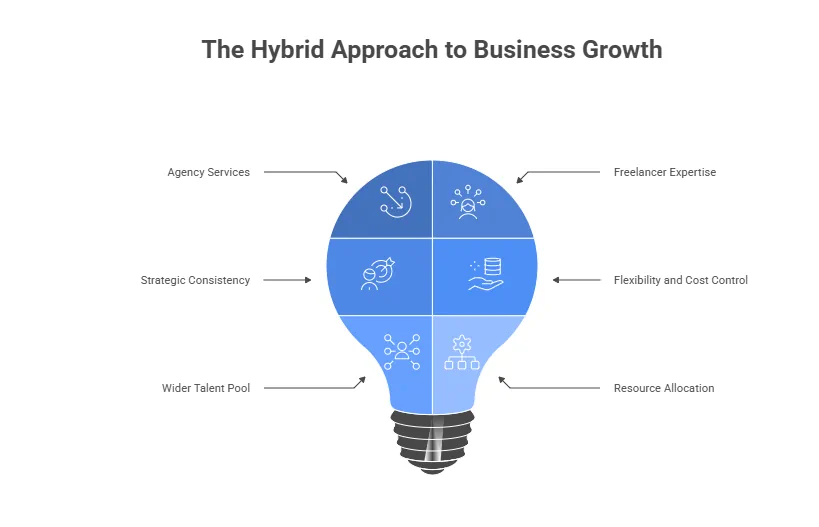
In 2026, many UK businesses will no longer choose strictly between freelancers and agencies. Instead, they are adopting a hybrid approach that combines the strengths of both models.
This approach typically involves using:
- An all-in-one agency for strategy, core systems, and long-term growth
- Freelancers for specialised, short-term, or creative tasks
For example, a business might use an agency to manage its website, SEO, and marketing strategy, while hiring freelancers for occasional design work or content creation.
This model works well because it offers:
- Strategic consistency from the agency
- Flexibility and cost control from freelancers
- Access to a wider talent pool
- Better resource allocation depending on project needs
The hybrid approach allows businesses to stay agile while still maintaining a strong foundation, making it a popular choice for growing companies in the UK market.
Common Mistakes Businesses Make When Choosing
Choosing between freelancers and an all-in-one digital agency can significantly impact your business growth, but many UK business owners make rushed decisions that lead to inefficiencies later on. These mistakes are usually not about the providers themselves, but about unclear expectations and poor planning.
Choosing Based Only on Price
One of the most common mistakes is selecting a provider purely because they are cheaper. While budget is important, the lowest cost option is not always the most cost-effective in the long run.
Freelancers may seem cheaper upfront, but additional costs can arise from revisions, coordination, and inconsistent work quality. Similarly, agencies may seem expensive at first, but they often deliver better long-term value through integrated services and strategy.
Ignoring Long-Term Business Goals
Another major issue is failing to think beyond immediate needs. Some businesses hire freelancers or agencies only to solve a short-term problem without considering how it fits into their long-term growth plan.
For example, a website built without future scalability in mind may need a complete rebuild later. Similarly, disconnected marketing efforts may not support brand consistency over time.
Poor Vetting and Research
Many businesses also rush into hiring without proper research. This can lead to working with unreliable freelancers or agencies that do not understand the UK market or the specific needs of the business.
Before making a decision, it is important to review:
- Case studies and past results
- Client testimonials and reviews
- Communication style and responsiveness
- Experience within your industry
Lack of Clear Objectives
Without clear goals, even the best digital partner will struggle to deliver effective results. Businesses that do not define what they want often end up with scattered outcomes and wasted resources.
Setting clear objectives such as increasing sales, improving visibility, or streamlining operations helps ensure that both freelancers and agencies deliver meaningful results.
Conclusion
Choosing between freelancers and an all-in-one digital agency is not a one-size-fits-all decision. Each option offers distinct advantages depending on your budget, goals, and stage of business growth.
Freelancers are ideal for short-term, specialised, or budget-conscious tasks, offering flexibility and direct control. However, they can become difficult to manage when your business starts to scale or requires multiple connected services.
On the other hand, an all-in-one digital agency provides structure, consistency, and long-term strategic support. For UK businesses aiming to grow sustainably in a competitive digital landscape, this often becomes the more reliable and scalable option.
In many cases, the most effective approach is a balanced one, using freelancers for specific tasks while relying on a trusted agency for core digital strategy and growth.
If you are looking to build a stronger, more scalable digital foundation for your business, exploring DataXpie’s all-in-one digital solutions can help you bring everything together under one clear and growth-focused strategy.