

Introduction
In today’s competitive digital marketplace such as SEO, UK small businesses face a tough challenge — getting noticed online by the right people in their local area. Whether you run a café in Manchester or a plumbing service in Bristol, appearing at the top of Google’s local results can make or break your business.
Table Of Content
- Introduction
- Why SEO is Vital for Small Businesses in the UK
- Keyword Research (UK Focus)
- On-Page SEO Best Practices
- Technical SEO Essentials
- Local SEO Optimisation
- Content Strategy
- Link Building and Authority
- Final SEO Checks Before You Launch
- Measuring & Iterating for Long-Term Success
- Conclusion: Turn Your Website into a Local Lead Magnet
Search engine optimisation (SEO) isn’t just about attracting website visitors; it’s about drawing in customers who are actively looking for what you offer. This ultimate SEO checklist is designed to help UK small business owners strengthen their local presence, improve visibility on Google, and build a sustainable flow of new leads in 2025.
By following these practical steps — from technical SEO to local optimisation — you’ll transform your website from a digital business card into a powerful, lead-generating machine.
Why SEO is Vital for Small Businesses in the UK
For many small business owners, SEO might feel like a technical mystery. Yet, the numbers make it clear: 70–90% of all B2B buying processes begin with an online search (source: edgeoftheweb.co.uk). Even for local shops, trades, and service providers, search engines are the first stop for new customers.
The Power of Local Search
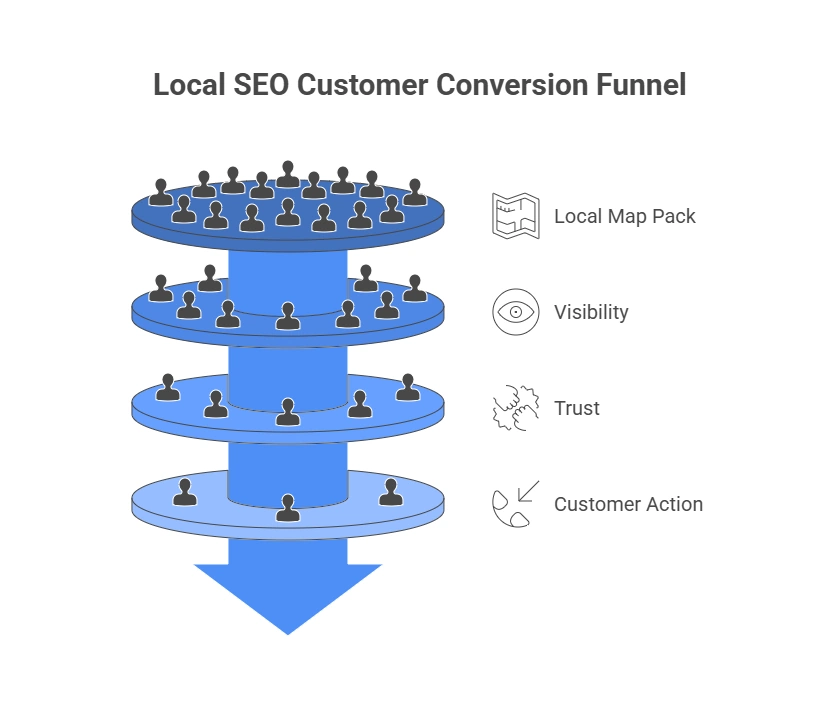
When someone types “best accountant near me” or “plumber in Leeds” into Google, they’re not browsing — they’re ready to buy. Google’s Local Map Pack, which displays the top three nearby businesses, dominates these search results. If your business isn’t optimised to appear there, you’re likely missing out on high-intent local leads every single day.
Why Organic Visibility Beats Paid Ads
Paid ads can be useful, but they stop driving traffic the moment you stop paying. SEO, however, is an investment that builds long-term visibility and credibility. For UK small businesses operating on tight budgets, organic traffic offers a steady stream of customers without ongoing ad spend.
Trust and Brand Authority
Ranking highly on Google gives your business instant credibility. Consumers naturally trust the brands they see first. In a local context, this means more phone calls, website visits, and store footfall — all because Google associates your business with relevance and reliability.
UK Example in Action
Take a local bakery in London. By optimising its Google Business Profile, including “artisan bakery London” in its titles, and encouraging customer reviews, the bakery can move up the local rankings. That visibility turns casual searchers into real, loyal customers walking through the door.
Keyword Research (UK Focus)
Keyword research is the foundation of every successful SEO strategy. It helps you understand exactly what your potential customers are searching for — and how you can position your business to meet that need. For UK small businesses, targeting localised and long-tail keywords can make all the difference between competing with big brands and winning relevant, high-intent traffic.
Focus on Local and Long-Tail Keywords
Instead of broad terms like “web designer” or “accountant,” focus on specific phrases that reflect how UK users actually search. For example:
- “Affordable accountant for small business UK”
- “Best café in Manchester city centre”
- “24-hour plumber near Bristol”
These long-tail keywords not only attract more qualified traffic but also face lower competition, making it easier for smaller websites to rank.
Use Reliable Keyword Tools
You don’t need expensive software to get started. Free or affordable tools such as Google Keyword Planner, Ubersuggest, or Ahrefs provide keyword ideas with search volume, difficulty, and related terms. Combine these with Google’s “People Also Ask” and “Related Searches” sections to discover what UK users are asking.
Include Regional and UK-Specific Terms
Incorporate city names, counties, or regional phrases into your keywords and headings. For example:
- “digital marketing agency London”
- “best takeaway in Glasgow”
- “SEO consultant for small business UK”
Adding these terms signals to Google that your business serves a specific location, helping you appear in local searches and map listings.
Understand Search Intent
Not all searches are equal. Some users want to buy now (“emergency electrician Birmingham”), while others seek information (“how to reduce small business tax UK”). Tailor your content to match the user’s intent — informative blogs for research, service pages for buyers.
On-Page SEO Best Practices
Once you’ve identified your target keywords, the next step is to make sure every page on your website is optimised for both users and search engines. On-page SEO is about clarity, relevance, and structure — ensuring that Google easily understands what your business offers and who it serves.
1. Craft Compelling Titles and Meta Descriptions
Your title tag (up to 60 characters) and meta description (up to 160 characters) are often the first things users see in search results. Include your primary keyword and location naturally.
Example:
- Title: “Affordable Cleaning Services in Leeds | SparkClean UK”
- Meta Description: “Professional cleaning for homes and offices in Leeds. Trusted local cleaners with fast booking options — SparkClean UK.”
2. Structure Content with Headings
Use H1 for your main topic, followed by H2 and H3 subheadings. This helps readers scan easily and signals hierarchy to search engines. Naturally include keywords in some headings but avoid overstuffing.
3. Optimise URLs
Clean, descriptive URLs improve both usability and SEO. For instance:
✅ www.yourbusiness.co.uk/seo-services-london
❌ www.yourbusiness.co.uk/page?id=123
4. Add Image Alt Text
Every image should have ALT text describing what’s shown, using relevant local keywords when appropriate (e.g., “Birmingham bakery shop front”). This helps with accessibility and allows your images to appear in Google Image search results.
5. Internal Linking for Better Navigation
Include links between related pages on your website — for example, linking your “Services” page to relevant “Case Studies” or “Blog” posts. This helps users navigate easily and assists Google’s crawlers in understanding your site structure.
6. Write for People First
While optimisation matters, user experience comes first. Use natural language, short paragraphs, and clear calls to action (like “Call now” or “Get a quote”). A positive reader experience leads to longer page visits and higher engagement — both ranking factors.
Technical SEO Essentials
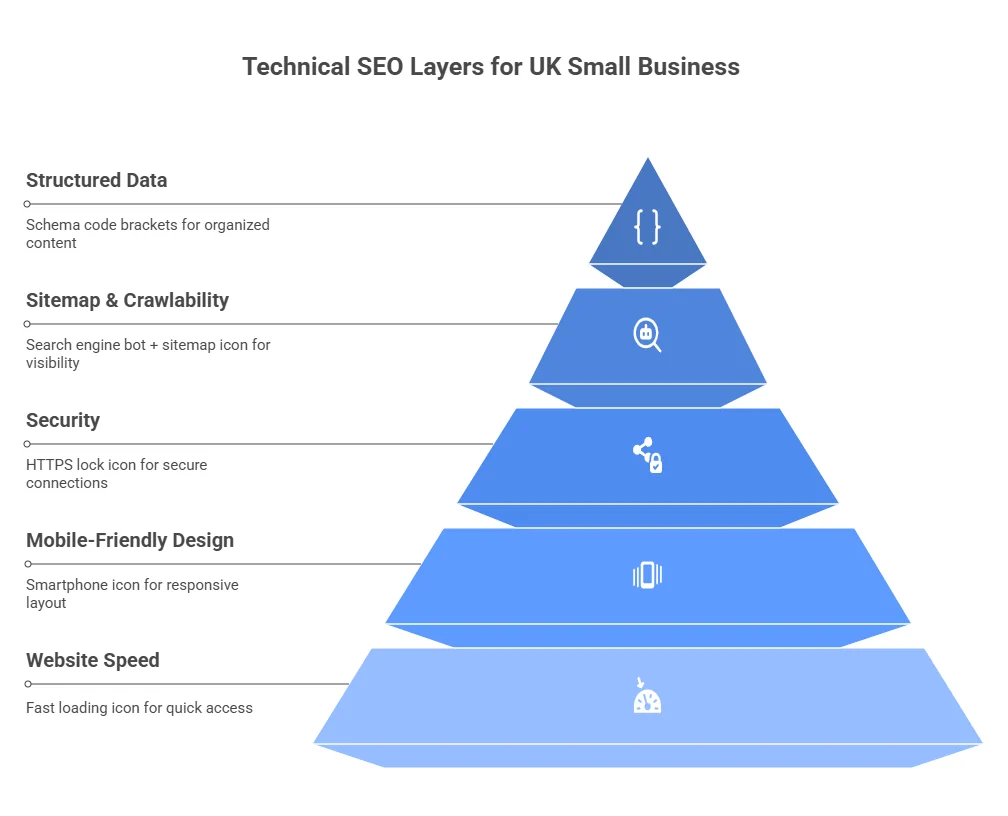
Even the best-written content won’t rank well if your website isn’t technically sound. Technical SEO focuses on the behind-the-scenes factors that make your website fast, secure, and easy for both users and search engines to access.
A well-optimised technical foundation ensures that when someone searches for your business, your site loads quickly, looks great on mobile, and is properly indexed by Google. Here’s what every UK small business should prioritise in 2025:
1. Speed Matters
A slow website can kill conversions. Research shows that sites taking more than three seconds to load lose a significant number of visitors (source: charle.co.uk).
- Use Google PageSpeed Insights or GTmetrix to test speed.
- Compress images and use next-gen formats (like WebP).
- Enable browser caching and use a reliable UK hosting provider.
2. Mobile-Friendly Design
Most searches in the UK now happen on smartphones, and Google uses mobile-first indexing, meaning it primarily ranks your mobile version.
- Use a responsive design that adjusts to all devices.
- Test your site on Google’s Mobile-Friendly Test Tool.
- Ensure buttons and text are easy to tap and read on small screens.
3. Secure Your Site with HTTPS
Security is a must. An SSL certificate (HTTPS) not only protects data but also boosts rankings since Google considers it a ranking factor.
- Install a free certificate via Let’s Encrypt or your hosting provider.
- Make sure all URLs redirect to the HTTPS version.
4. Optimise Crawlability and Indexing
Search engines need to understand your site structure.
- Create and submit an XML sitemap in Google Search Console and Bing Webmaster Tools.
- Maintain a clean robots.txt file to guide search crawlers.
- Use canonical tags to avoid duplicate content issues.
5. Add Structured Data (Schema Markup)
Implement Schema.org structured data for your LocalBusiness, Products, and Services. This helps Google display rich snippets such as ratings, pricing, or event details in search results — increasing visibility and click-through rates.
6. Fix Errors and Broken Links
- Regularly check for 404 (Not Found) errors.
- Use 301 redirects when pages are moved or renamed.
- Keep your internal links updated and consistent.
Local SEO Optimisation
If you want nearby customers to find your business, Local SEO is your secret weapon. It’s all about ensuring your business appears in Google’s local map results and other location-based searches that drive real foot traffic and calls.
Google Business Profile (GBP)
Your Google Business Profile is the cornerstone of your local SEO presence.
- Claim and verify your listing using your Google account.
- Ensure your NAP (Name, Address, Phone) details are 100% accurate and match your website.
- Add business hours, photos, and service descriptions.
- Use GBP posts to share updates, events, and offers — these act like mini social posts that boost engagement.
Pro Tip:
Businesses with complete profiles are 2.7x more likely to be considered reputable by potential customers.
Local Citations
Local citations are online mentions of your business’s key details — typically your NAP — on directories, business listings, and social platforms. Consistency is the key.
- List your business in UK-specific directories such as Yell, FreeIndex, Thomson Local, and FSB.
- Check for typos or outdated addresses — even small inconsistencies can confuse Google’s algorithms.
- Join local chambers of commerce or trade associations that link back to your site.
These citations act like trust signals, confirming your legitimacy to both search engines and potential customers.
Customer Reviews
Positive reviews don’t just build credibility — they also directly affect your rankings in the Google Map Pack.
- Encourage customers to leave at least five genuine reviews on Google and Facebook.
- Respond to every review, good or bad. Engagement shows you value feedback.
- Avoid fake reviews — authenticity is crucial for reputation and compliance with UK consumer protection laws.
Pro Tip:
Adding screenshots of positive reviews to your website’s testimonial section can reinforce trust and conversions.
Local SEO in Action
Imagine a small hair salon in Birmingham. By claiming its Google Business Profile, adding location-rich keywords like “Birmingham hairstylist,” getting listed on Yell, and gathering positive reviews, it could move into the top 3 of Google’s local results — right where customers are searching for services nearby.
Content Strategy
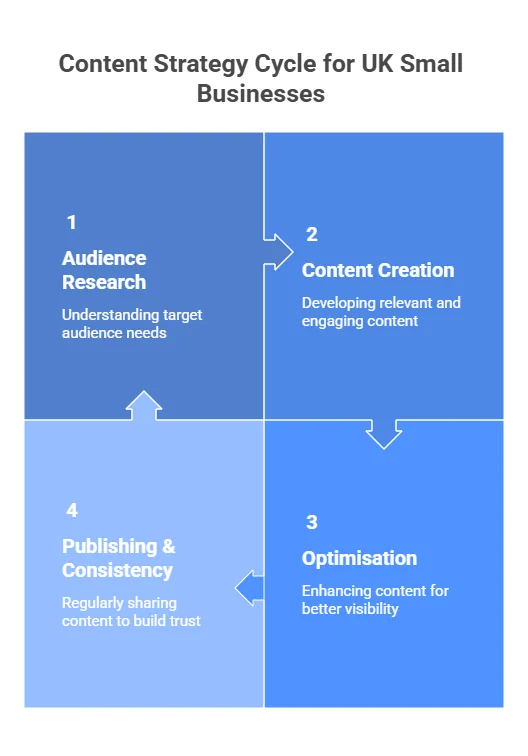
When it comes to SEO, content is the backbone of your online visibility. For small businesses in the UK, creating useful, relevant, and localised content is what helps you stand out in a crowded digital landscape. Search engines reward businesses that publish fresh, informative content that genuinely helps users — not just sells to them.
1. Write for Your Customers’ Pain Points
Every good piece of content starts with understanding your audience. Ask yourself:
- What questions do my customers frequently ask?
- What challenges do they face that I can solve?
Create blog posts, FAQs, or short guides that address these pain points. For instance, an accountant could write: “5 Tax Mistakes UK Small Businesses Make and How to Avoid Them.” This type of value-driven content attracts readers, builds trust, and positions your business as a helpful local expert.
2. Create UK-Specific Content
Search engines love localisation. Write posts or pages that address UK-specific rules, trends, or topics. Examples:
- “How to Choose the Best Courier for Small Businesses in the UK”
- “Business Grants Available for Startups in England 2025”
Including these local references signals to Google that your content is relevant to users searching within the UK.
3. Keep It Fresh and Consistent
Consistency matters more than quantity. Publishing regular updates — even just once or twice a month — signals to Google that your website is active.
- Maintain a content calendar.
- Update older posts with new stats or local insights.
- Reuse successful posts by turning them into infographics, social posts, or videos.
4. Optimise Each Post
Don’t forget the SEO fundamentals when publishing content:
- Include your target keywords naturally in the title, first paragraph, and subheadings.
- Add internal links to related pages (like your services or contact page).
- Insert external links to trustworthy UK sources for credibility.
- Always add a clear call to action — such as “Book a free consultation today” or “Download your free checklist.”
Link Building and Authority
Search engines view links from other websites as votes of confidence. In simple terms, the more trustworthy websites that link to yours, the more authority your site gains in Google’s eyes. But not all links are equal — it’s about quality, not quantity.
1. Build Internal Links First
Start with what you control. Internal links (links between your own pages) help visitors and search engines navigate your site easily.
- Link relevant blog posts to service pages.
- Use descriptive anchor text like “learn more about our SEO services in London” instead of generic “click here.”
- Create a simple hierarchy — home → services → subpages → blog posts — to distribute link equity evenly.
2. Earn Quality Backlinks
Backlinks from trusted UK websites can give your rankings a major boost. Here are practical ways to get them:
- Partner with local businesses and exchange website mentions (e.g., “Recommended by [Partner Business]”).
- Get featured in UK online directories like Yell, FreeIndex, or Trustpilot.
- Pitch stories or insights to local newspapers, industry blogs, or podcasts.
- Sponsor or collaborate with community events or charities — many will link to your site as a partner.
3. Avoid Spammy Link Schemes
Buying backlinks or joining link farms may sound tempting, but they often backfire. Google’s algorithms are sophisticated and penalise manipulative tactics. Always focus on natural link-building through credibility, not shortcuts.
4. Combine PR and SEO
Think beyond traditional SEO — digital PR is one of the most effective ways for UK small businesses to build authority. Sharing press releases, business milestones, or community involvement stories can attract both publicity and backlinks from reputable UK outlets.
5. Promote Content Actively
Once you’ve published high-quality blogs or guides, promote them:
- Share on LinkedIn, Facebook, and X (Twitter).
- Send snippets through your email newsletter.
- Ask partners or clients to share your content if it’s useful to their audience.
This proactive approach signals authority and drives real referral traffic — not just SEO points.
Final SEO Checks Before You Launch
You’ve optimised your content, refined your keywords, and earned valuable links — now it’s time to ensure everything is technically and strategically ready to perform. A few overlooked details can make or break your search rankings, so this stage is crucial.
1. Test Website Speed and Mobile-Friendliness
Google prioritises fast, mobile-friendly websites. Use tools like Google PageSpeed Insights or GTmetrix to measure load time and identify areas for improvement.
- Aim for under 3 seconds of load time.
- Compress large images.
- Remove unused plugins or scripts.
- Use a Content Delivery Network (CDN) if your site attracts users from multiple UK regions.
Mobile responsiveness is non-negotiable — over 60% of local searches come from smartphones. Check how your website appears on different screen sizes and fix any layout issues before launch.
2. Double-Check Indexing and Sitemaps
Your beautifully optimised site won’t help if search engines can’t crawl it.
- Submit your XML sitemap via Google Search Console and Bing Webmaster Tools.
- Ensure there are no “noindex” tags on important pages.
- Verify your robots.txt file allows search engines to access your main content.
3. Review Metadata and Headers
Each page should have a unique title tag (max 60 characters) and a compelling meta description (max 160 characters) that includes your focus keyword and UK relevance.
Example:
Title: “Affordable Web Design Services for UK Startups”
Meta: “Discover professional, SEO-friendly web design services tailored for UK startups. Fast, secure, and mobile-ready websites that convert visitors into clients.”
Check your H1 and H2 headings too — they should logically structure your page and include your target phrases.
4. Check Forms and CTAs
Before launching, test all your website’s forms and buttons. A broken contact form or inactive “Book Now” button can cost real leads.
- Test every form submission.
- Ensure calls, WhatsApp links, and map directions work smoothly.
- Use tracking tools (like GA4 Events) to see which CTAs convert best.
5. Secure and Monitor
Finally, install an SSL certificate to keep your site secure (look for “https://”). Security isn’t just for trust — it’s also a Google ranking factor.
Measuring & Iterating for Long-Term Success
SEO doesn’t stop once your site goes live — it’s an ongoing process of monitoring, adapting, and improving. Small businesses that treat SEO as a continuous investment, rather than a one-time setup, see the strongest long-term results.
1. Monitor Key Metrics Regularly
Track your site’s performance using Google Analytics 4 (GA4) and Search Console. Focus on:
- Traffic sources: Where are visitors coming from (organic, social, referrals)?
- Top-performing pages: Which content attracts the most visits and engagement?
- Conversion rates: How many visitors take action (call, email, purchase)?
- Keyword rankings: Are you climbing for your target UK search phrases?
2. Adjust Based on Data
If certain keywords or pages are underperforming, don’t panic — use the insights to tweak your strategy.
- Update underperforming blog posts with new data or better headlines.
- Add internal links to boost weaker pages.
- Create new content around search terms gaining traction.
SEO success comes from data-informed iteration, not guesswork.
3. Keep Building Reputation
Online reputation is a ranking signal. Continue to:
- Request and respond to Google reviews.
- Keep your Google Business Profile updated with fresh posts, new images, and correct business hours.
- Encourage satisfied clients to share testimonials on both your site and third-party directories.
4. Stay Ahead with Industry Trends
Google updates its algorithm frequently. Stay informed by following SEO blogs, UK marketing newsletters, or attending local business webinars. Adapting early gives your business an advantage before competitors catch up.
5. Celebrate and Scale
Once your site starts generating organic traffic and leads, celebrate your wins — then double down.
- Expand into nearby UK towns or service areas.
- Add new keyword clusters targeting specific services.
- Introduce automation or CRM tools to handle increased demand.
Your small business SEO journey doesn’t end — it evolves as your brand grows.
Conclusion: Turn Your Website into a Local Lead Magnet
Search engine optimisation isn’t just about ranking higher — it’s about connecting your small business with the customers who are already searching for what you offer. Whether you’re a café owner in Manchester, a web agency in Bristol, or a tradesperson in Leeds, following this UK-focused SEO checklist can transform your website into a steady source of local leads and credibility.
By mastering the essentials — from keyword research and technical SEO to Google Business optimisation and ongoing analytics — you’re building more than visibility. You’re creating a trusted digital footprint that search engines reward and customers rely on.
The key is consistency. SEO isn’t a one-time project; it’s a continuous process of testing, refining, and improving. The businesses that stay proactive — keeping their content fresh, site secure, and reviews active — are the ones that dominate local search results in 2025 and beyond.
Ready to Take the Next Step?
If you’re ready to amplify your local SEO performance, but need expert guidance or time-saving support, DataXpie can help.
Our team specialises in helping UK small businesses grow through:
- Tailored SEO audits that identify hidden opportunities
- On-page and technical SEO services designed for local markets
- Content and Google Business strategies to boost customer trust and engagement
Let us handle the technical side — so you can focus on running and growing your business.
👉 Get in touch with Website SEO at DataXpie today to see how we can turn your website into a lead-generating powerhouse for 2025 and beyond.